Imagine building a skyscraper or even a simple family home. You invest in the best cement and the strongest TMT steel bars. But did you know that a small detailing mistake—like not bending a reinforcement bar correctly at a lap joint—can slowly lead to cracks, misalignment, and even structural weakness over time?
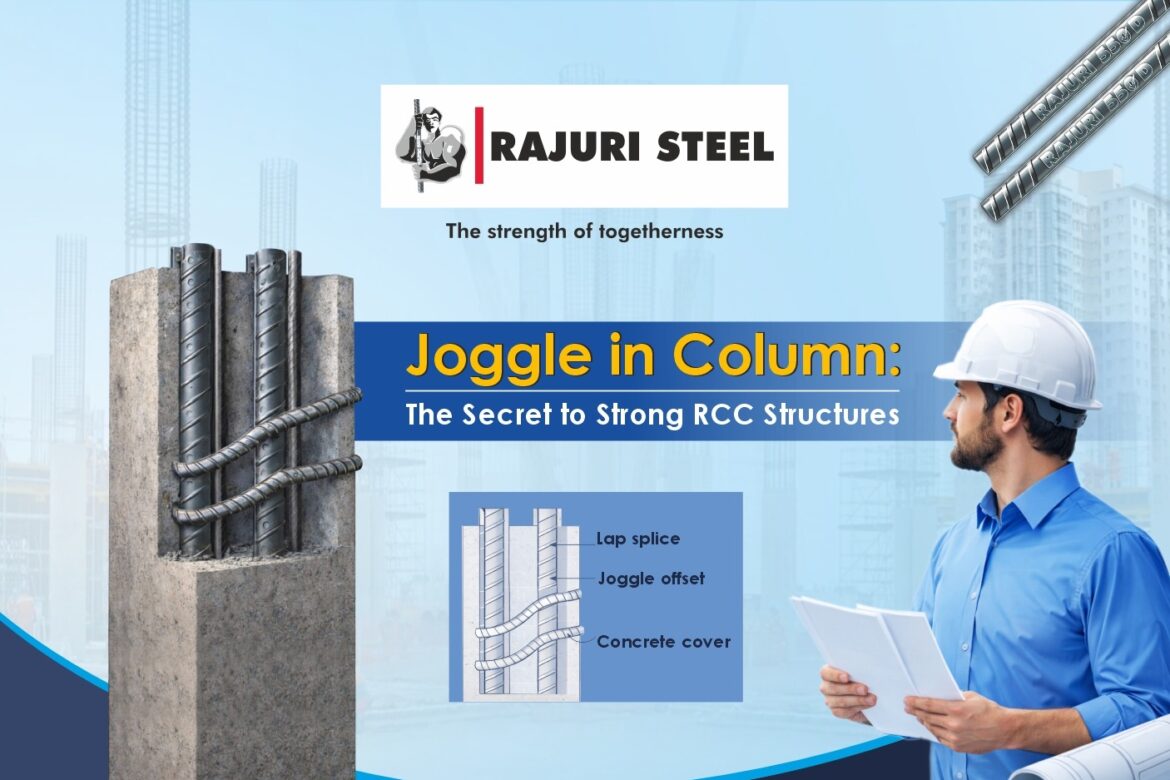
This is where an often-ignored but highly important detail called Joggle in Column comes into the picture. A joggle is a small intentional offset provided in reinforcement bars at lap splice locations. Though it looks minor, it plays a major role in maintaining column dimensions, ensuring proper concrete cover, avoiding steel congestion, and enabling smooth load transfer between old and new bars.
In this blog, we will clearly understand what a joggle is, what joggle length means, and why it is a critical RCC practice for strong and durable columns.
What is Joggle in Column?
A joggle is a small, intentional bend or offset given to vertical reinforcement bars at the lap splice zone in RCC columns. When two bars overlap for continuity, this offset helps keep both bars within the column core and in their correct position.
By providing a proper joggle, reinforcement remains aligned and does not shift towards the outer surface of the column. This ensures the required concrete cover, reduces steel congestion, and allows smooth transfer of forces between the existing bar and the new bar, resulting in a stronger and more durable column.
It helps in:
– Maintaining correct column size and shape
– Ensuring uniform and sufficient concrete cover
– Avoiding congestion of steel bars
– Keeping reinforcement properly aligned
– Providing efficient load transfer between lapped bars
The Technical Rule (Joggle Slope)
As per standard RCC practice, the joggle is provided with a slope of 1:6 (horizontal : vertical), which means that for every 6 units of vertical length, the reinforcement bar is shifted 1 unit horizontally. This gentle and gradual bend is very important because it avoids sudden changes in direction of the steel, which can create stress concentration and reduce the strength of the bar.
By maintaining this 1:6 slope, the joggle ensures that forces are transferred smoothly from one portion of the bar to the other without developing weak points. It also helps in keeping the lapped bars properly aligned within the column section, maintaining the required concrete cover and allowing concrete to flow and compact properly around the reinforcement, thus improving the overall durability and safety of the RCC column.
What is Joggle Length?
Joggle length is the inclined length of the reinforcement bar provided at the lap splice zone. The bend is gradual, not sharp, so that stresses are smoothly transferred and cracking of steel is avoided.
Example:
If horizontal offset = 20 mm
Then joggle length = 6 × 20 = 120 mm
Correct joggle length ensures:
– Proper alignment of bars
– Adequate concrete cover
– Efficient force transfer in RCC columns
Why is Joggling Important?
1. Proper Load Transfer:
Columns transfer building load to the foundation. Without joggling, lapped bars become eccentric, leading to uneven force distribution, cracks, and possible buckling under high axial loads.
2. Maintaining Clear Cover:
Concrete cover (generally 40 mm in columns) protects steel from corrosion. Without joggle, overlapping bars push steel outward, reducing cover and increasing corrosion risk.
3. Vertical Alignment:
Joggling keeps column centreline aligned from floor to floor. Without it, slight offsets accumulate, reducing global stability.
4. Congestion Control:
Straight overlapping bars cause congestion, blocking concrete flow and resulting in honeycombing. Joggling creates space for proper compaction.
Correct Lapping Procedure in Columns
Lapping must follow IS code practices for earthquake resistance:
– Lapping Zone: Middle one-third height (L/3), not at beam–column joint
– Staggering: Only 50% bars lapped at one level
– Lap Length: Generally 50d (50 × bar diameter)
– Ring Spacing: 100–150 mm in lap zone
Common Mistakes to Avoid
One of the most common mistakes is heating the reinforcement bars to make the joggle, which reduces the strength and ductility of steel and should never be done. Providing very sharp or sudden bends instead of a smooth 1:6 slope creates stress concentration points that can lead to cracking or failure of the bar, especially during earthquakes. Another serious error is giving the joggle at the wrong location, such as inside the beam–column joint or in highly stressed zones, which disturbs proper load transfer and can weaken the overall performance of the column.
– Heating bars for bending (reduces steel strength and ductility)
– Providing sharp bends instead of smooth 1:6 slope
– Giving joggle inside beam–column joint or highly stressed zones
Conclusion
In RCC construction, detailing is as important as material quality. A correctly provided joggle ensures proper alignment, adequate cover, smooth force transfer, and effective lap splicing in columns. Though small in size, a joggle with correct 1:6 slope plays a vital role in improving column performance, reducing cracking, and enhancing earthquake resistance.
Strong detailing today ensures safe structures tomorrow.