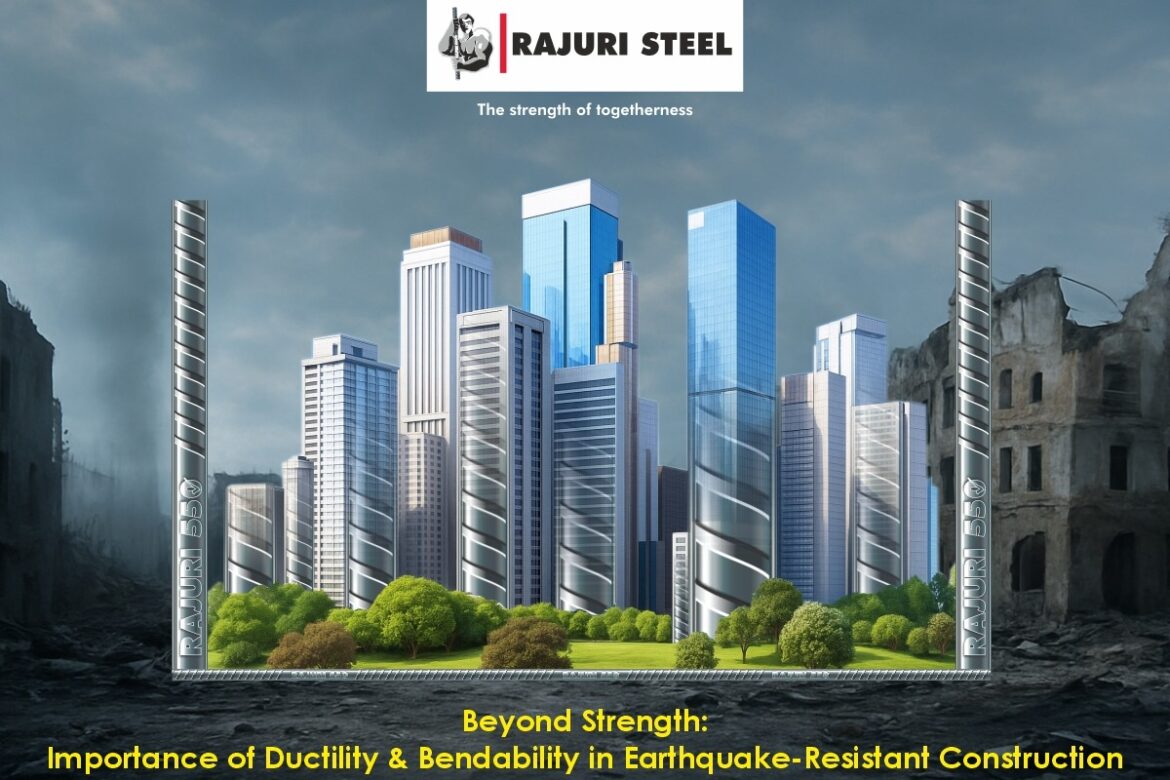
When building a structure, it’s natural to focus on strength — the ability of a material to withstand a maximum load. However, in regions prone to seismic activity, relying on strength alone is a recipe for disaster. The true measure of a building’s resilience lies in its capacity to move with the earthquake, not rigidly fight it.
At Rajuri Steels, we understand that for a building to be truly safe, its foundational reinforcement must offer the perfect balance of both high strength and exceptional ductility. This is the core of earthquake-resistant construction.
The Seismic Secret: Why Ductility Trumps Strength Alone
Ductility is the ability of a material, like a TMT bar, to deform plastically (stretch and bend) under stress without immediately fracturing.
1. The Danger of Brittle Failure
Imagine a very strong but rigid glass rod. It can withstand a large, steady load, but a sudden, sharp jolt — like an earthquake tremor — will cause it to shatter instantly and catastrophically.
Traditional high-strength TMT bars that lack sufficient ductility can behave in the same way. When seismic waves hit, these materials can reach their breaking point quickly, leading to sudden and brittle structural collapse.
2. The Power of Energy Dissipation
A highly ductile TMT bar, such as the premium grades offered by Rajuri Steels, acts like a shock absorber. When a structure is stressed beyond its elastic limit during a quake:
– The ductile steel reinforcement (rebar) bends, stretches, and deforms in a controlled manner.
– This deformation absorbs and dissipates the massive seismic energy, preventing the energy from building up and causing instant collapse.
– The structure sways, giving inhabitants crucial time to evacuate — often preventing total failure.
This approach is known as designing for “life safety.”
The key lies in a high Elongation Percentage — the measure of how much a bar can stretch before breaking. A higher elongation percentage equals greater ductility and better seismic performance.
Bendability: A Key Indicator of On-Site Performance
Bendability is the practical, on-site manifestation of a TMT bar’s ductility.
In construction, workers must bend TMT bars to create hooks, stirrups, and structural joints such as L-bends or U-bends. Poorly ductile bars will crack or break during manual or machine bending, wasting material and compromising the structure’s integrity.
Rajuri Steels’ Commitment to Bendability:
The superior bendability of Rajuri Steels’ TMT bars ensures:
Precision Detailing: Critical elements like column ties and beam stirrups — which require tight bends and are vital for seismic confinement — are formed accurately without micro-cracks.
Faster, Safer Work: The inherent flexibility allows for easier cold bending on construction sites, reducing labor time and the risk of bar failure during installation.
Our TMT bars are manufactured using advanced German Thermex Technology to create a unique microstructure — a soft, ductile inner core and a tough, strong outer surface. This dual nature ensures maximum strength while maintaining the flexibility necessary for life-saving seismic performance.
Understanding Grade ‘D’: The Benchmark for Earthquake-Ready Steel
For earthquake-resistant projects, engineers specifically look for high-ductility grades.The ‘D’ designation in grades like Fe – 500D stands for Ductile and signifies steel that meets superior elongation and weldability standards mandated for seismic zones.
At Rajuri Steels, we don’t just sell steel — we provide a foundation of trust and safety. When you choose our high-ductility TMT bars, you’re choosing a material engineered not only for strength but also for the resilience that saves lives when the earth trembles.