
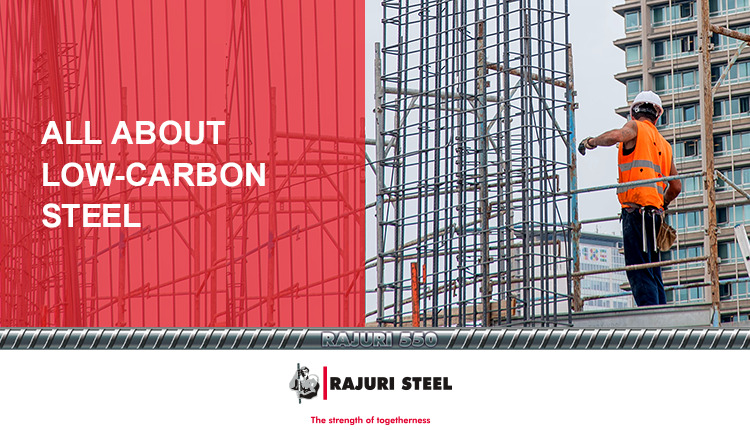
Low-Carbon Steel: A Sustainable Choice for Modern Industry
Since the industrial revolution, iron and steel production has been powered by coal. This is now changing, and the steel sector is evolving to supply goods and services in a future in which the emission of carbon dioxide and other greenhouse gases is drastically reduced.
Low-carbon steel is the form of carbon steel that is most frequently utilized and these steels usually include less than 0.25 percent carbon. It cannot be made Martensitic by heating it; instead, cold practice is used to harden the material. Carbon-based are often delicate and low-obstructive. Eventually, they do have a great degree of flexibility, which is fantastic for ease of machining, welding, and other processes.
In order to make specialized building materials, barrels, frames, furnaces, and farm equipment, low carbon steel is normally not heat treated before use and is instead rolled into steel edges, channel steel, I-beams, sheets, strips, or plates. For deep-drawn goods like automobile cabs and engine covers, strong-quality low-carbon steel is produced into a type of thin plate; mechanical parts with modest strength requirements are frequently rolled into bars.
Why can’t low-carbon steels be heat treated?
Low-carbon steels are robust, machinable, weldable, and resistant. They are thus ideal for cold working. A ductile metal is hardened through a process known as cold working, also known as strain hardening when it is plastically deformed at temperatures quite close to the absolute point of melting. We focus on the “Hardening” process alone because this is where we find heat control. We are considering a heat-treatment procedure that involves heating the steel to 850–900 degrees centigrade, quenching it, and then producing a martensitic microstructure.
Steels that yield more than 0.3% C are often subjected to martensitic heat treatments. The improvements in the strength of these steels are most essential However, it can be difficult to temper steels with less than 0.3% C, to achieve exceptional strength and hardness combinations in sheets and thin plates.
All Comments:
The blog titled “All About Low-Carbon Steel” summarizes low-carbon steel’s relevance in the environment and its basic characteristics. Overall, the blog gives a concise introduction to low-carbon steel. Expanding on some points and adding real-world contexts will make it more informative and engaging for readers.