India’s construction and infrastructure sectors are growing at an unprecedented pace. With this rapid development comes a critical challenge—managing resources responsibly while meeting rising demand. In this evolving landscape, steel scrap is no longer seen as waste. Instead, it has emerged as a valuable resource that plays a key role in shaping a more sustainable and efficient construction ecosystem.
As the industry shifts towards smarter practices, the focus is not just on building faster, but on building responsibly. Integrating recycled materials like steel scrap helps reduce environmental impact while maintaining the strength and reliability required for modern structures. This shift reflects a larger movement towards sustainable growth in India’s construction sector.
Understanding Steel Scrap
Steel scrap refers to recycled steel obtained from industrial processes, construction activities, and end-of-life structures. Unlike many other materials, steel can be recycled multiple times without losing its core properties, making it highly efficient for reuse in manufacturing.
It is broadly categorised based on its source and usability:
– Industrial Scrap: Generated during manufacturing processes such as cutting, shaping, and machining.
– Construction Scrap: Leftover or discarded steel from construction and demolition sites.
– Obsolete Scrap: Steel recovered from old structures, machinery, or vehicles at the end of their life-cycle.
This classification helps manufacturers select and process scrap efficiently, ensuring consistent quality in the final steel products. By understanding the nature and source of scrap, the industry can maximise its value while maintaining high performance standards.
The Transformation Process: Up-cycling Waste into Strength
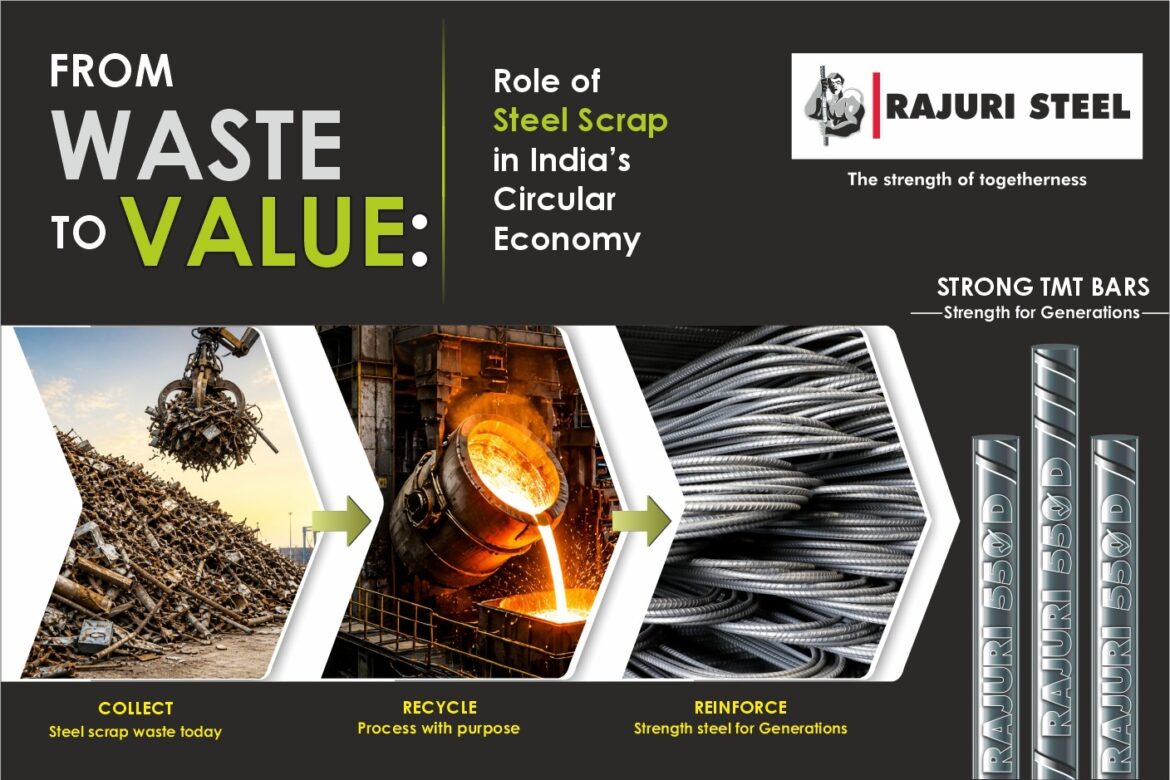
The journey from a scrap yard to high-quality TMT bars is a carefully controlled and technologically advanced process. It is not just about recycling, but about refining and upgrading the material to meet modern construction standards. Each stage is designed to ensure purity, consistency, and strength in the final product, turning discarded steel into a reliable construction material.
Process Overview:
– Scrap Collection & Sorting:Scrap is carefully collected and sorted using advanced methods to ensure it is free from unwanted materials and suitable for processing.
– Melting & Purification:The sorted scrap is melted at very high temperatures, where impurities are removed to produce clean and high-quality molten steel.
– Refining & Continuous Casting:The molten steel is further refined and cast into billets, which serve as the base for manufacturing steel products.
– Rolling & Forming:These billets are reheated and shaped into specific sizes and forms through rolling processes.
– TMT Production (Final Stage):The steel bars undergo thermo-mechanical treatment, creating a strong outer surface and a flexible inner core, ensuring the right balance of strength and durability required for construction.
Role of Steel Scrap in India’s Circular Economy
A circular economy focuses on reducing waste and maximizing the reuse of resources, and steel scrap plays a crucial role in this system. Instead of being discarded, scrap is reintroduced into the production cycle, helping create a continuous loop of material use. This significantly reduces the need for virgin raw materials and minimizes industrial waste.
In a rapidly developing country like India, where infrastructure demand is constantly rising, using steel scrap supports more responsible and efficient growth. It not only conserves natural resources but also contributes to building a more sustainable and future-ready construction ecosystem.
Benefits of Scrap-Based Steel in Construction
The use of steel scrap in manufacturing brings multiple advantages to modern construction. It supports cost efficiency by optimizing resource usage while maintaining consistent quality in the final product. Scrap-based steel also aligns with sustainable building practices, helping reduce the environmental impact of construction projects.
For builders and developers, this means access to reliable, high-performance steel that not only meets structural requirements but also supports responsible construction. It enables projects to achieve a balance between strength, efficiency, and sustainability.
At Rajuri Steel, this approach is integrated into our manufacturing philosophy, ensuring that every TMT bar reflects both strength and responsible resource utilization.
Conclusion
The transformation of steel scrap from waste to value highlights a powerful shift in the way construction materials are produced and utilized. As India continues to grow, adopting circular practices like scrap-based steel manufacturing will play a key role in building a more sustainable future.
By choosing smarter resource solutions today, the construction industry can build structures that are not only strong, but also aligned with the future of sustainable development.