
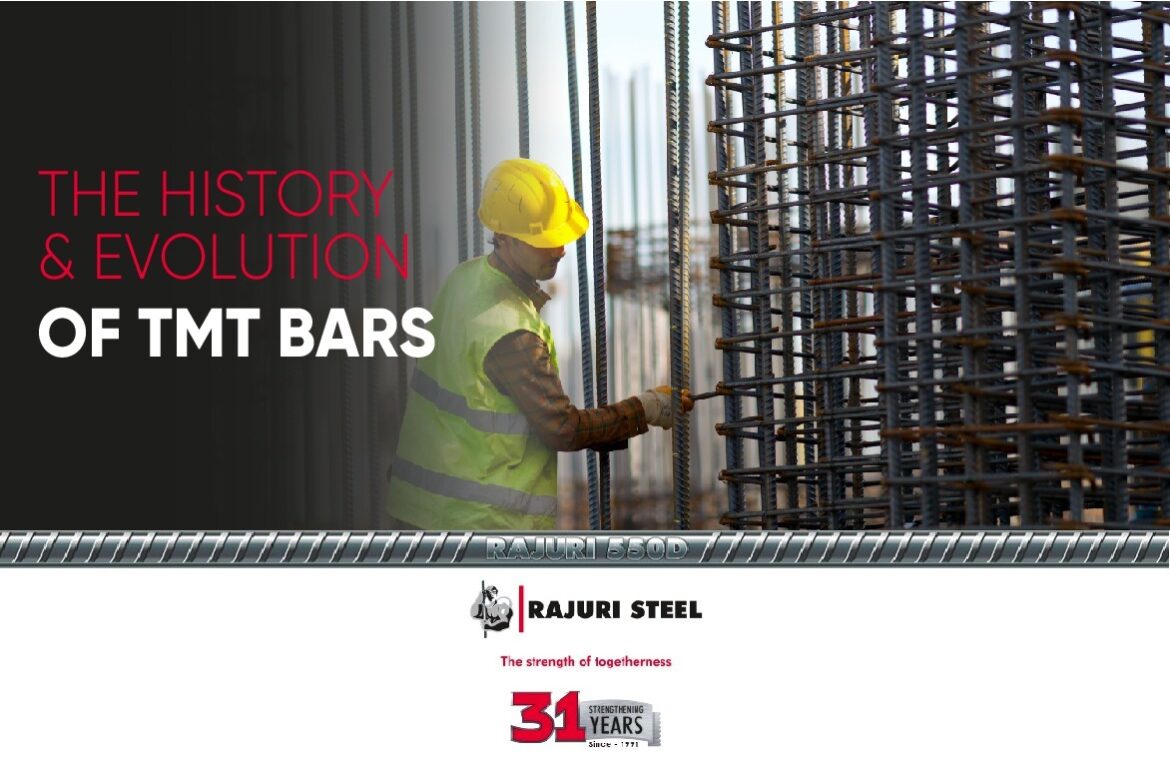
Invention:
The history of steel and of TMT bars is the story of development. From the time steel was first invented in the 13th century BC, to its high-tech applications in modern times, steel has powered major social, economic, and cultural changes and forms the backbone of the world’s economy today.
Steel is a proven match for Reinforced Cement Concrete (RCC) which was invented in 1867. No other material has as much strength, flexibility, and reliability as RCC, which is now the most commonly used construction material. Concrete is very strong in compression but comparatively weak in tension. Steel is very strong in tension and provides tensile strength to concrete. Thermal expansion for both steel and concrete is nearly the same. Steel bonds well with concrete, and its excellent bendability makes it the best material for reinforcement in concrete structures.
Evolution:
In the initial days of steel manufacturing, mild steel (MS) bars were used to reinforce concrete. By the end of World War II, deformed high-strength rebars started becoming popular around the world. Cold twisted and hot-rolled deformed rebars became widely used. The yield stress of cold twisted deformed (CTD) bars was 415 MPa against 250 MPa of MS rebars. Though the chemical compositions of MS and CTD bars were nearly the same, the physical strength of CTD bars was 60% higher than MS steel bars.
With the advancement of construction methods and technologies over the next two decades, there arose the demand for stronger reinforcement with higher yield strength. The thermo-mechanical treatment (TMT) of reinforced steel was one resulting innovation. The manufacturing process comprises of heating the rebars to about 900 °C and then quenching them to about 450 °C in a few seconds, resulting in a softer ferrite-pearlite core and a harder martensite periphery. First introduced in 1979, these TMT bars came in grades Fe 415 and Fe 500. Since then, the demand for TMT bars rose across the world, due to their optimum combination of high strength, ductility, bendability, and other desirable properties. If construction requires 1000 tons of reinforcement with MS bars, with TMT bars the consumption will be only about 400 tons!
Indian Standards:
In India, the classic plain mild steel bars and rods were used till the mid-1960s when CTD bars were introduced. Due to their simpler production process, and significant savings in the rebar consumption in construction, CTD bars replaced MS bars by 1975. TMT bars were introduced in India during 1980-1985. Today, most steel companies in India manufacture Fe 500 or Fe 550 TMT bars.
Conclusion:
Due to the number of benefits they provide, TMT bars are the most acclaimed and preferred construction material across the world and in India, contributing to economic growth and development.

All Comments:
The History and Evolution of TMT Bars is a good informative article. Thanks for sharing…
Steel is one of the worlds most recyclable materials; it can be used and reused an infinite number of times. Steel scrap is obtained from steelworks, old vehicle bodies, ship containers, buildings, and a host of consumer items. Although most steel in the world is produced using iron ore as the primary raw material, steel scrap is increasingly being used as the secondary raw material for steel production using the EAF method.