
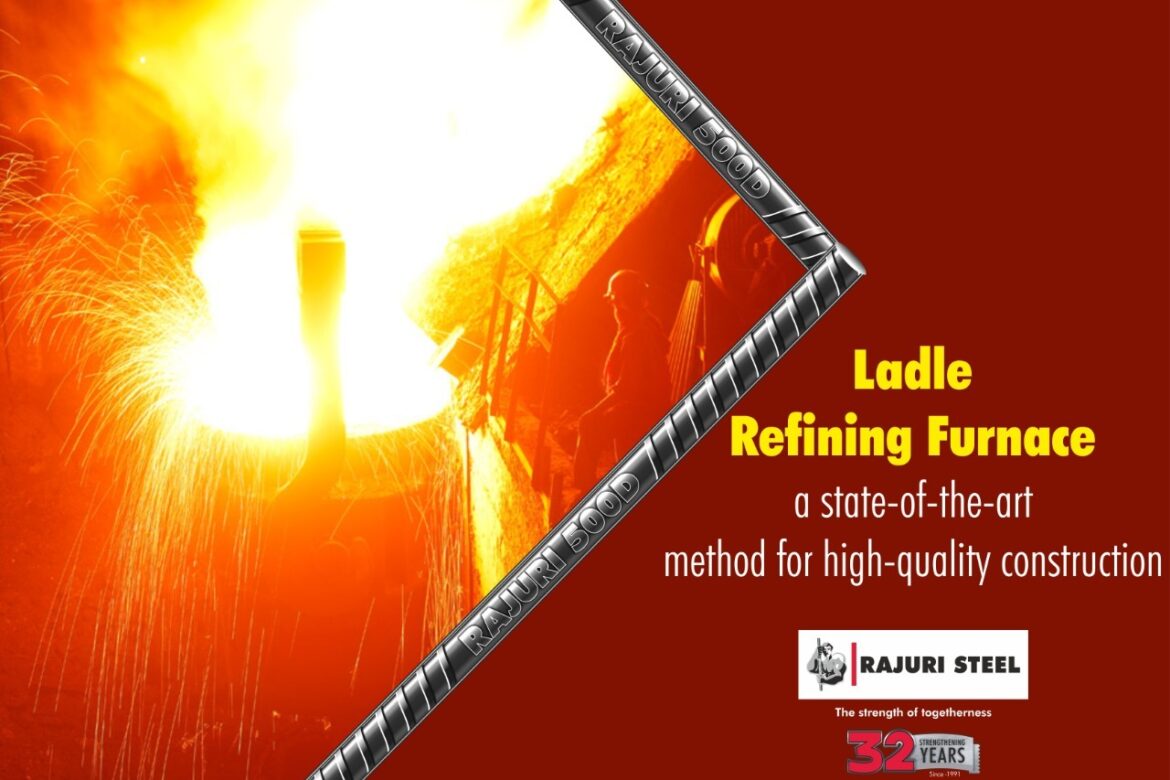
The ladle refining furnace (LRF) process has recently become popular among steel manufacturers for the production of construction-grade steel. Large-scale infrastructure projects, ports, bridges, dams, as well as high-rise buildings all of these projects, need the use of high-grade TMT bars and LRF is the ideal process for producing high-quality construction-grade TMT bars.
What is a Ladle Refining Furnace?
To desulfurize steel, remove other impurities and hold the molten steel for casting processes Ladle Refining Furnaces (LRF) are used. Once the basic steel has been produced in an oxygen furnace, arc furnace, or induction furnace the steel is then transferred to the ladle for further refinings, such as chemistry adjustment or inclusion modification. The treatment is carried out in the ladle. As additional heat is required for these operations, the heat source is provided to heat the liquid metal and compensate for thermal losses.
In other words, LRF improves the quality of steel by refining and heating. Steel refining in a ladle is called secondary metallurgy in the field of process metallurgy.
Benefits of the LRF method:
1. Homogenization of chemical composition and temperature of molten steel.
2. Deoxidization or removal of oxygen inclusions
3. Heating of the liquid steel to a temperature suitable for continuous casting
4. Reduction of hydrogen and nitrogen
5. Removal of carbon for meeting the requirement of specific steel grades.
6. As low as 0.002% of sulfur concentrations reduction
7. Reduction of unwanted nonmetallic elements
8. Improvement in toughness, ductility, and transverse properties
9. Save consumption of Ferro Alloys
10. Increases productivity as the melting furnace gets emptied earlier
The main functions of the Ladle Refining Furnace:
1. Heat up and heat preservation of Liquid Steel:
To obtain new heat energy liquid steel is heated by an electric arc, which can add alloy and adjust the composition and also add slag to facilitate deep desulfurization and deoxidization of liquid steel.
Furthermore, the initial temperature of the liquid steel needed for continuous casting is guaranteed, which is beneficial for improving the quality of dry casting billets.
2. Argon stirring function:
By blowing argon into the liquid steel through the permeable brick installed at the bottom of the ladle, the liquid steel obtains a certain stirring function.
3. Vacuum degassing function:
When the ladle is lifted into a vacuum tank, the steam jet pump is used to vacuum degassing, and argon is blown into the bottom of a ladle to stir the liquid steel, this removes the hydrogen and nitrogen content in the liquid steel. furthermore, it reduces oxygen and sulfur and finally produces liquid steel with high purity and excellent properties.
The application of a ladle refining furnace can speed up the production rhythm and improve production efficiency. At present, it is the most effective process for producing high-quality construction grades steel.

All Comments:
It’s great to see the increasing adoption of ladle refining furnace (LRF) processes in steel manufacturing for high-quality construction materials like TMT bars. This technology is indeed a significant step forward in ensuring the durability and safety of large-scale infrastructure projects. LRF helps enhance the quality and performance of TMT bars, which are critical components in the construction industry. Its ability to reduce impurities and control the composition of steel makes it an ideal choice for ensuring structural integrity. I’m curious to hear more about the advantages and challenges associated with the LRF process from those who have practical experience with it in the industry.
I’m eagerly waiting to hear more about the process of LRF and how can we produce good steel for the future