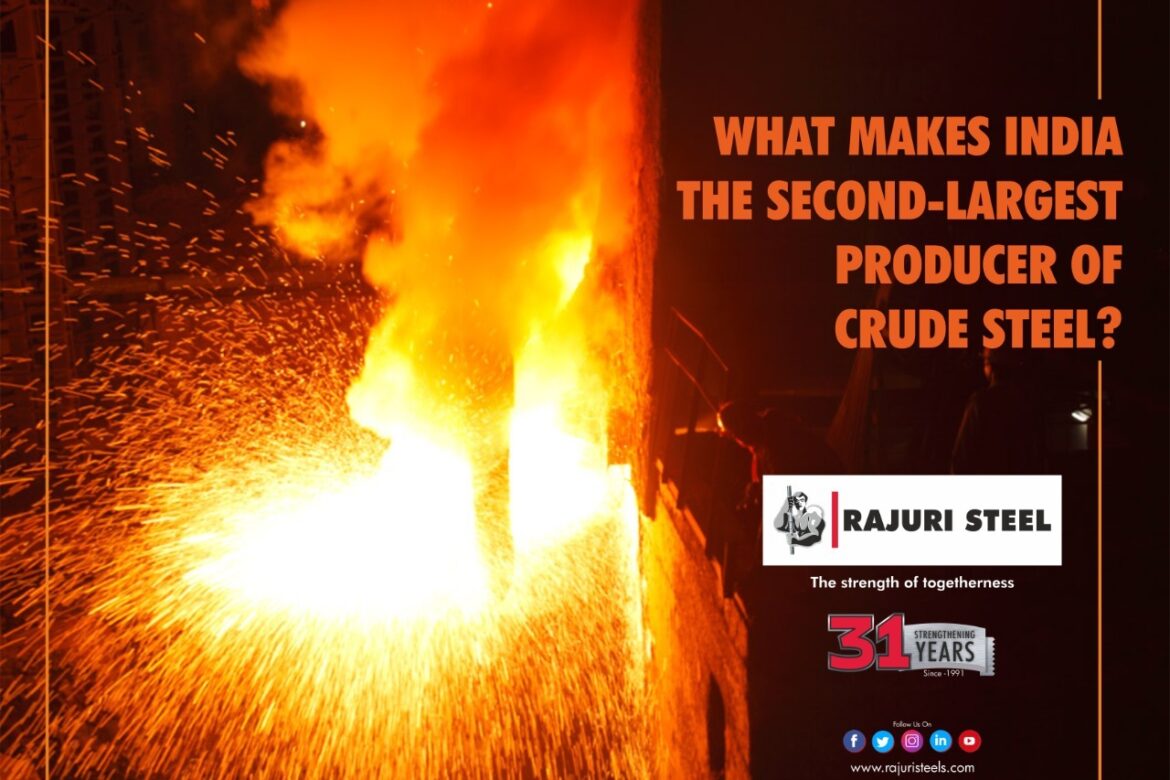
By replacing Japan, India now ranks as the second-largest producer of crude steel after China.
Ministry of Steel declared that India’s crude steel production in 2018 was 109.3 million tones, an increase of 7.7 percent from 2017, and in 2019, this increased to 111.2 million tonnes. The Indian steel industry is categorized into three types – major producers, main producers, and secondary producers.
The development in the Indian steel sector has been driven by the domestic availability of raw materials such as iron ore and cost-effective labour. Therefore, the steel sector has been a major contributor to India’s manufacturing output.
The Reason Behind The Growth in Indian Steel Industry:
Steel has several inherent benefits like durability, faster completion time, reduction in environmental impact. Steel plays a crucial role in the Indian economy.
1. Crude steel capacity and production of India:
Since 2014-15, crude steel production and capacity have shown a sustained peak. The production capacity of crude steel in India accounted for around 142 million metric tons at the end of 2020. The constant growth could be observed during the current period, which ensures that India remains a dominant player in the global steel market.
2. Share of the various routes of production in India:
The Indian steel industry is generally structured in between three comprehensive categories based on route-wise production, i.e. BOF, EAF, and IF. This ensures the Indian steel industry remains extremely diverse. One of the key factors for India’s robust growth rate in crude steel capacity has been the remarkable growth rate in the electrical route of steelmaking (EAF and IF).
3. Consumption of Steel:
As per the data released by the World Steel Association, the per capita consumption of finished steel for the year 2019-20 was 74.7 kg.
4. India’s strong steel input industries:
The growth in crude steel and finished steel production of India has been supported by vibrant sponge iron and pig iron industries, which act as essential inputs for the steel industry. Since 2003, India has been the world’s leading producer of sponge iron & has coal-based units in the mineral-rich states of the country. India is also a producer of pig iron. After liberalization, by setting up many units in the private sector, not only decreased imports drastically but also India turned into a net exporter of pig iron.
5. Finished steel production and net export/import scenario:
Over the past 5 years, the increasing demands and strong growth in crude steel capacity have led India’s finished steel production to witness a 6% CAGR. By meeting strong domestic demand, India has become a global exporter and has also reduced import requirements.
6. National Steel Policy 2017:
To create a technologically advanced and globally competitive steel industry that promotes economic growth, the government has framed the National Steel Policy 2017. The policy aims to achieve autonomy in steel production by providing good policy support and guidance to the MSME steel producers, private manufacturers, CPSEs, etc.
Continued positive investment and government intervention in the field of investment can lead the Indian steel sector to a position of global leadership that can yield rich dividends for India, such as rapid GDP, industrialization, huge employment, and wealth creation.
Rajuri steel – one of the leading premium quality TMT bar manufacturers with over 31 years of expertise in the field, committed to shaping the infrastructural development of the country. The TMT bars have the ideal balance of exceptional flexibility and strength for sturdy constructions and not only ensures high durability but also improves the longevity of any building.
Rajuri Steel TMT bars with revolutionary State-of-the-art technology give your home the strongest foundation that you deserve. Our extensive range of products demonstrates exceptional mechanical and chemical properties and are more sustainable choices across industries.