
Choosing the Right TMT Bars for Strong and Reliable Construction
With the changing times, people are rapidly building their houses, which results in increased construction work in India. The quality of construction depends mainly on the materials used. The building materials you choose determine the overall durability and strength of the building. Therefore care must be taken while choosing construction materials.
The most important element used in construction is the TMT bar, on which the endurance of the entire building depends. Therefore, the TMT bar used in construction should be of the best quality.
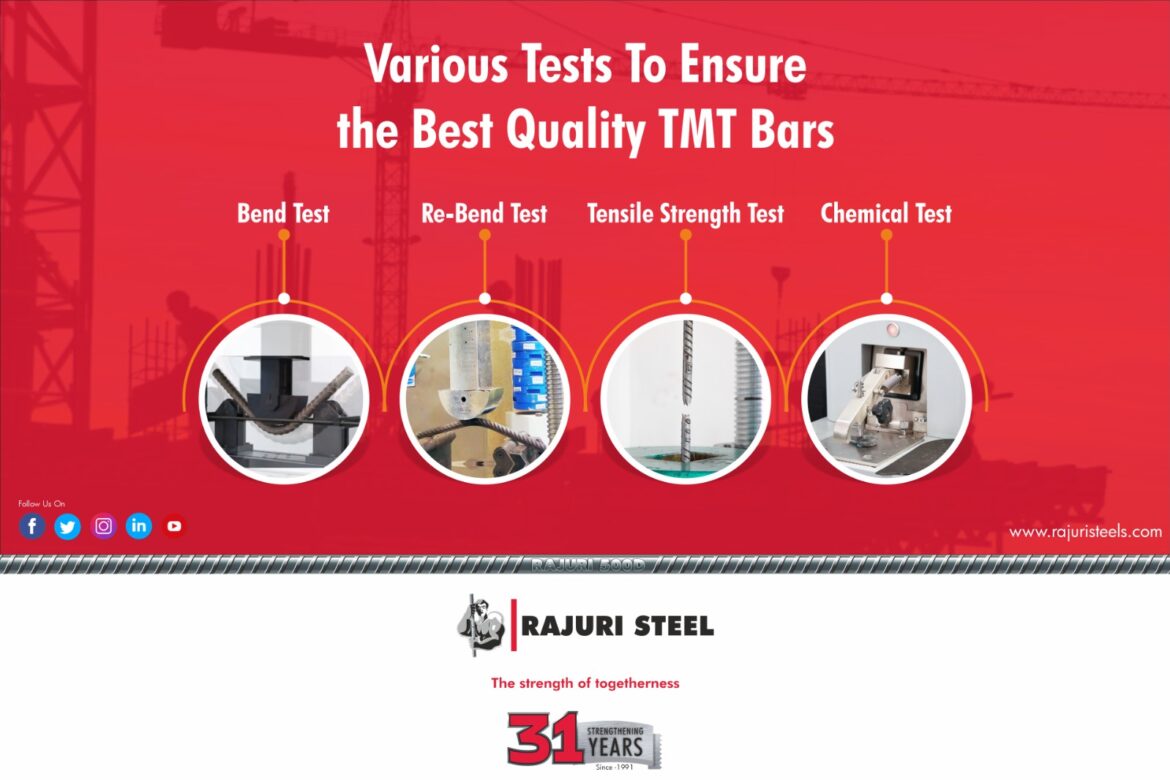
TMT Bars come in varying grades like Fe500, Fe500D, and Fe550, the numbers represent the yield strength. Wondering about How to ensure that the TMT bars are of the best quality? There are specific tests that determine the strength, elongation properties, and quality of the TMT bars.
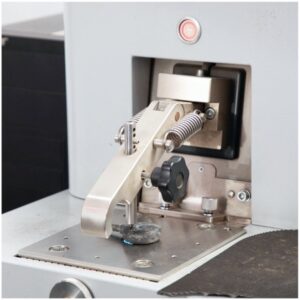
- Tensile Test
- Bend and Rebend Test
- Yield Stress Test
- Chemical Analysis Test
1. Tensile test –
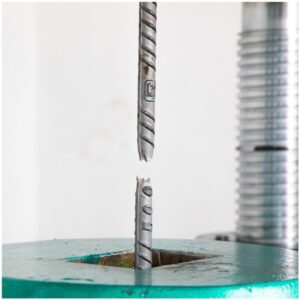
The tensile test process is one of the important tests of the TMT bars. According to IS 1786 specifications, TMT Bars having a capacity of up to 32mm can be tested without the need of a UTM (Universal Testing Machine) which measures the strength of reinforcement bars however, above 32mm you would need the machine to test. This test is done to decide how the material responds when force applies to it.
2. Bend and Rebend Test –
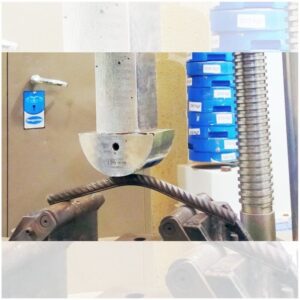
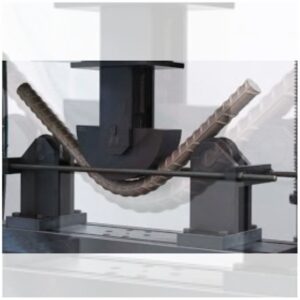
There are several scenarios we can find that TMT Bars are becoming deformed, it often occurs due to improper material handling. It is a necessity to be careful while bending and re-bending the TMT bars at the construction place. Incorrect bending can harshly have an effect on the performance of steel reinforcement in service.
The bend test consists of bending the TMT bar at 180 degrees angle and observing, the bar should not crack or rupture if it is of good quality. The Re-bend test entails bending the bar at 135 degrees and observing the same. Put the bar in 100 degrees Celsius of water for 30 minutes, and bend it at 157 degrees, observe the rebar and see if it cracks.
3. Yield Stress Test –
The yield stress test is done to check, up to which level material can take the stress? and when does it start to deform plastically? the material will deform elastically until it reaches the yield point and gets back to its original form once the stress has been released. This is also called the 0.2% proof test. Material’s behavior is divided into two sections Ductile and Brittle, aluminum and steel are ductile, while cast iron and glass are brittle. Comparing the stress-strain curve makes it simpler to understand these categories.
4. Chemical Test –
Chemical composition testing is done in a spectrometer in Chemical Test. This test takes around 10 to 15 seconds to give results in printed form of an utmost 26 elements in the TMT bar. It shows the result of percentages of Phosphorous, Sulphur, and Carbon is necessary according to the BIS. The spectrometer also shows the percentages of copper, manganese, and chromium.
Conclusion:
Finding quality TMT bars can be a challenge. Fundamental characteristics of good quality TMT bars include strength and elongation. Always buy TMT bars from trusted brands that perform all tests to assess the quality of their TMT bars. At Rajuri Steels, we undertake the essential tests to ensure the quality and strength of the TMT Bars.
All Comments:
The introduction effectively establishes the increasing rate of construction in India and the significant role of construction materials in ensuring the quality of buildings. It sets a strong foundation for the subsequent points.